Training kit
A long band and a mini loop are different tools. Choose the format for the exercise rather than treating every elastic band as interchangeable.
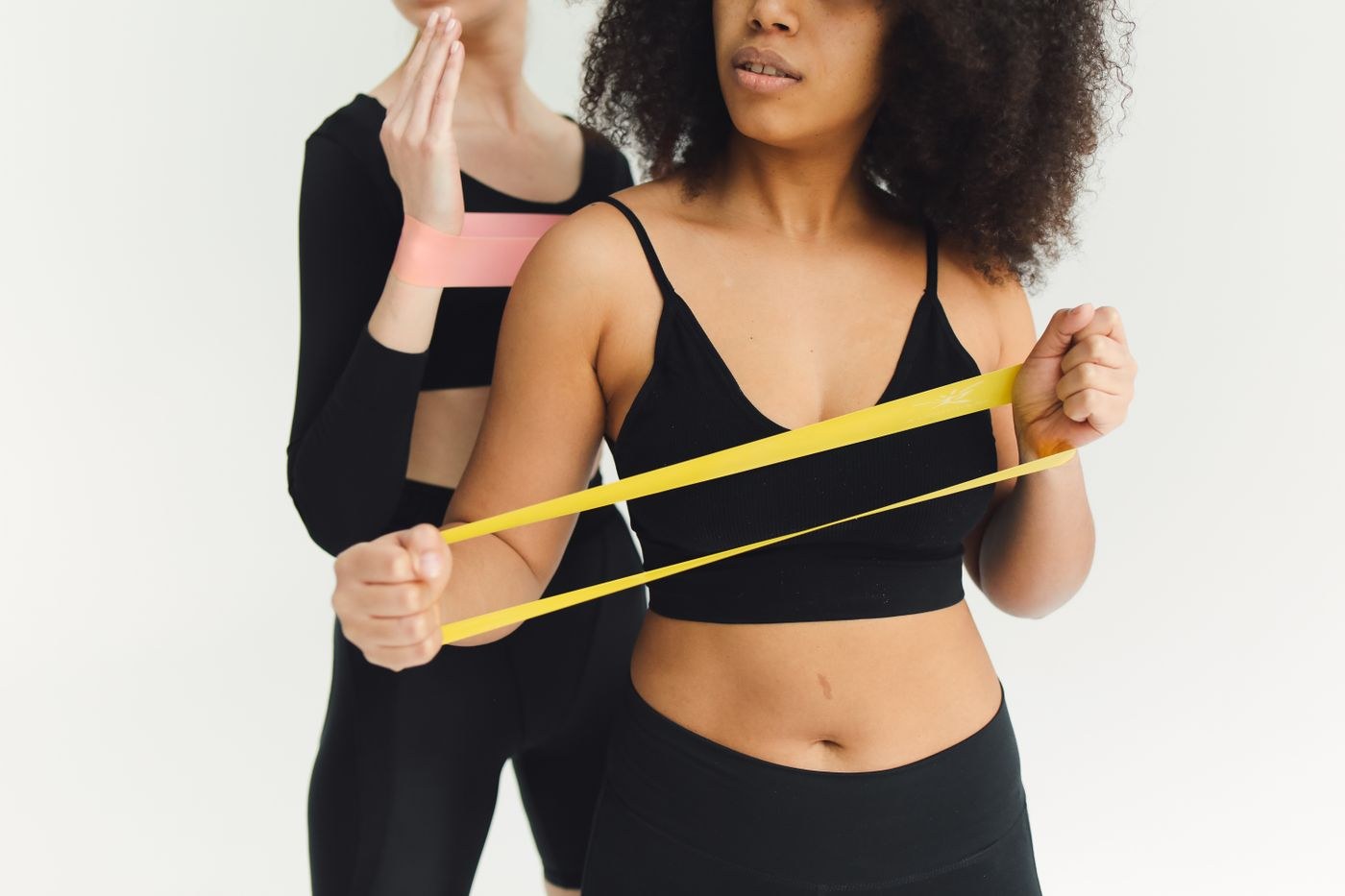
A long flat band can be held in the hands or used in a setup specified by its maker. Tubing may have handles and purpose-made attachments. A mini loop is a short closed band often used around the limbs. Length, width and attachment design affect which movements each can accommodate.
Start with an exercise you have been shown and identify the exact equipment it needs. Do not shorten a long band with an improvised knot or stretch a mini loop far beyond its intended range to imitate another product. If an exercise requires an anchor, the anchor and attachment method need their own safety check.
Colours are not a universal scale across manufacturers. Even within one range, the resistance depends on how far the band is stretched. Read the maker's description and choose a level that lets you complete the intended movement with control. A stronger band is not automatically a better purchase for a beginner.
If several people will use the equipment, they may need different resistance levels for the same exercise. You may also need different bands for different movements. A small useful selection is preferable to a large set whose ratings and attachments you do not understand.
A bundle may include bands, handles, an anchor and a storage pouch, but that does not mean every piece can be combined in every way. Check the instructions for which connections are permitted and whether resistance figures refer to one band, a particular stretch or a claimed total. Avoid adding several bands together unless the system explicitly supports that arrangement.
A useful comparison is a long flat band for a taught hand-held movement against a mini loop for a specific lower-body exercise. The first needs sufficient length and a secure, comfortable hold; the second needs an appropriate circumference and a surface that stays in place. Neither wins a general best-band contest because the jobs differ.
If you intend to travel with bands, consider whether the exercise requires an anchor that you can reliably provide. A hotel room or park may not offer one. Choosing an anchor-free exercise you already know can be more practical than buying a large attachment kit and improvising somewhere to fasten it. Portability should describe the whole setup, not just the rolled band.
Read the material information if latex is a concern, and do not infer that a fabric-covered product contains no latex. Check the full specification. Consider how the surface feels against skin and clothing and whether the band tends to roll or bunch during the intended movement.
Inspect before each use for cuts, cracks, thinning or damaged seams and handles. Keep bands away from sharp objects, jewellery and rough surfaces. Avoid a setup in which a slipping grip or failed anchor would send the band towards the face. Follow the manufacturer's stretch limits and replacement guidance.
After use, clean and store the band as directed, without leaving it stretched or trapped under heavy kit. A band is convenient because it is compact, but that does not make it maintenance-free. If you are uncertain how to set it up, ask an appropriately qualified instructor to demonstrate the exact format you own.