Movement basics
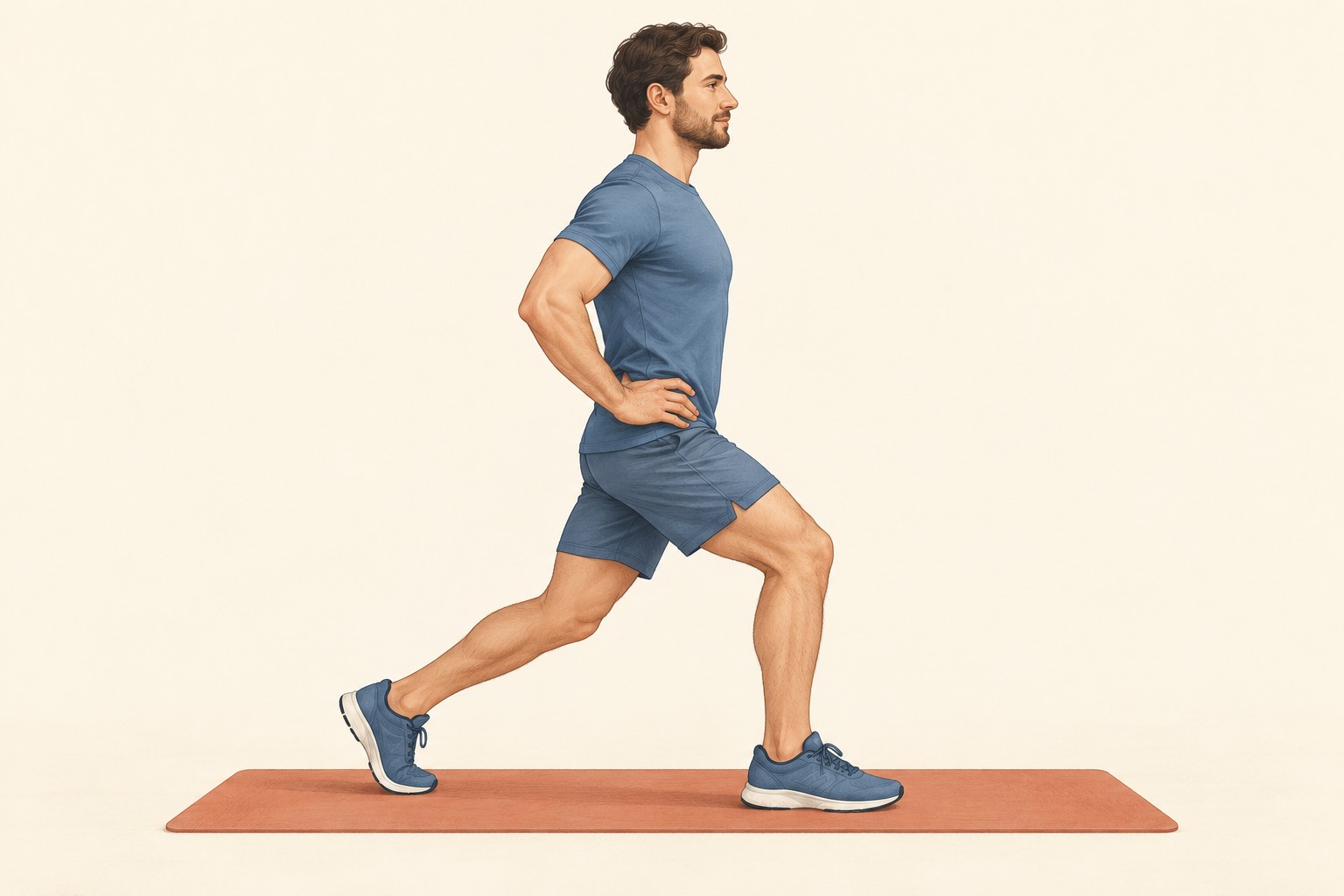
A reverse lunge introduces a backwards step and a split stance. Learning a smaller version helps you separate the foot placement from the depth of the bend.
Check the floor where the rear foot will land, not only the space in front of your mat. Remove bags, weights and curled mat edges. Stand where you can use a fixed support if needed, and begin without added resistance. A narrow corridor can make the exercise awkward even if there is enough room for one long step.
Set your feet with some width between them, as if each foot has its own track. Stepping directly behind the front foot can turn the task into a tightrope exercise. Before bending deeply, practise stepping back a comfortable distance and returning. Make sure you can place the rear foot without looking behind you during every attempt.
From the split stance, bend both knees a small amount while keeping the front foot securely grounded. Then return to standing with control. The rear knee does not need to touch the floor. Aim for a range that lets you remain steady rather than trying to reproduce a dramatic low position from a photograph.
If combining the step and bend is confusing, ask the instructor whether a stationary split-stance version would be a useful rehearsal. That removes the repeated backwards placement while you learn the bend. It is not a suitable substitution for every person, so check comfort and balance rather than assuming it will automatically solve the problem.
Avoid pushing the pace to match someone else's repetitions. A pause between sides gives you time to reset the stance and check the space. If the front foot shifts, the rear foot lands unpredictably or you need a large swing of the arms to recover, reduce the range and seek feedback.
Depth, step length, repetition count and load all influence the task. Keep most of them unchanged while learning. A longer step is not automatically a better lunge, and weights are not necessary for understanding the movement. An instructor can help you decide which change, if any, would serve your programme.
If you experience pain or a repeated feeling of giving way, stop rather than practising through it. Choose another task with appropriate guidance. The point of the smaller lunge is to make the pattern easier to observe and control, not to make an uncomfortable exercise compulsory by reducing its size.